What is Vector Search? An Introduction to Semantic Understanding
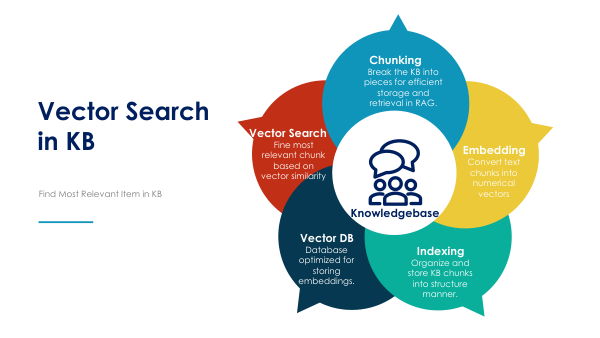
Vector Search is a fundamental search technique used to find similar items or data points, typically represented as vectors (or embeddings), within very large collections. It is the engine behind many modern AI applications, including recommendation systems and Retrieval-Augmented Generation (RAG) models.
The Core Concepts: Vectors and Embeddings
In this context, vectors, also known as embeddings, are lists of floating-point numbers that encode the semantic meaning of virtually any data—text, images, videos, or audio.
The "magic" of vectors is that data points with similar meaning or content will cluster closely together in a high-dimensional space, while dissimilar items will be far apart. This transforms the abstract idea of "similarity" into a concrete mathematical problem of measuring the distance between these points.
Vector Search vs. Traditional Keyword Search
Vector Search enables semantic search, which focuses on meaning and context, contrasting sharply with traditional search methods that rely on exact keyword matching.
Consider the following comparison:
- Traditional Search: If you search for "best pizza restaurant," the search engine looks for pages containing those exact words. It focuses on matching the keywords rather than understanding the intent.
- Vector Search (Semantic Search): The engine understands the intent behind the query. It looks for content discussing top-rated or highly recommended pizza places, even if the exact phrase "best pizza restaurant" is not present, returning results that are more contextually relevant.
Relevance in vector search is determined by assessing the similarity between the query vector and the document vector using a distance metric, such as Euclidean distance or Cosine similarity.
Applications and Use Cases
Vector search is critical for handling the vast majority of digital data, which is often unstructured (like text, images, and video). It is used in systems like:
- Recommendation Systems: Suggesting similar products or media (e.g., Netflix, Spotify).
- Semantic Text Search: Finding documents based on meaning rather than exact words.
- Reverse Image Search: Finding images similar to a query image.
- Retrieval-Augmented Generation (RAG): Powering large language models with external knowledge.
*Stay tuned for our next post where we dive into Vector Databases and indexing techniques like HNSW.*